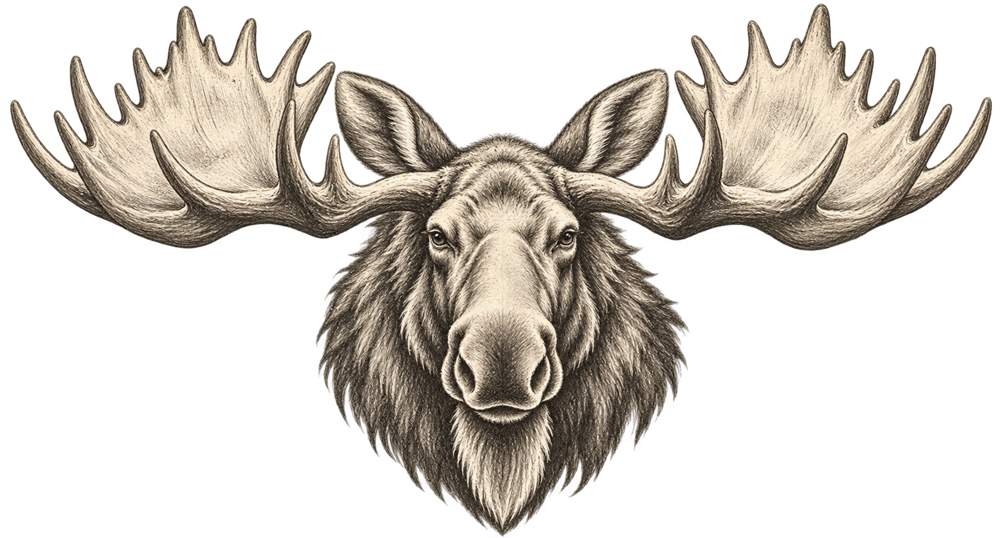
Moose habitat is more than a lake or a clearcut. An area needs food, shelter and workable routes between them. The mix changes with the season, the age of the forest and the snow.
Range across Ontario
Ontario’s moose habitat guidelines describe moose in the boreal forest and the Great Lakes–St. Lawrence forest. Southern Ontario is not one continuous moose range. A provincial report for WMU 65 describes separated patches of suitable habitat in that eastern part of the province.
A hunting-unit boundary is an administrative line, not the edge of a habitat type. Use Hunting Regions for client camp locations and the official WMU maps for boundaries.
Young growth and older cover
Fire and forestry can lead to young growth that supplies browse. Ontario describes useful moose landscapes as a mix of younger feeding areas and mature forest cover. A large opening with little nearby shelter is a different setting from browse beside woodland.
Ontario’s 2021 forest report also describes moose habitat as a mix of wetlands and forests of different ages. Its habitat measures use forest information. They describe the landscape; they are not a count of the animals standing in it.
Winter changes the value of cover
As snow builds, dense conifer cover can become useful winter habitat. Ontario’s significant wildlife habitat guide treats these winter concentration areas as a seasonal habitat concern.
The 1988 moose guideline discusses the limits deep or crusted snow puts on movement. The short distance between feeding and shelter can matter more in winter than it did during an easy summer walk.
Do not assume a summer shoreline sighting names the winter area. Compare dates and conditions when asking an operator about repeated use.
Read the whole neighbourhood
| Map feature | Question to check on the ground |
|---|---|
| Young forest or shrub growth | Is there reachable browse and recent moose sign? |
| Wetland or shoreline | Which plants and trails are actually being used? |
| Mature woodland | Is it close to feeding ground, and what cover does it provide? |
| Road or trail | Is access permitted, passable and safe for the trip? |
Save a map point and the date when you find useful sign. Keep habitat notes separate from access notes: a good feeding patch may still be outside the tag’s unit or on land where you lack permission.
Sources & further reading
- Ontario moose habitat guidelines (1988) ↗
- Ontario: habitat and moose survival ↗
- Ontario forest report (2021) ↗
- Ontario: seasonal wildlife habitats ↗
- Ontario WMU 65 population objectives report ↗
Sources checked October 14, 2026. Survey years and historical publication dates are stated where used.