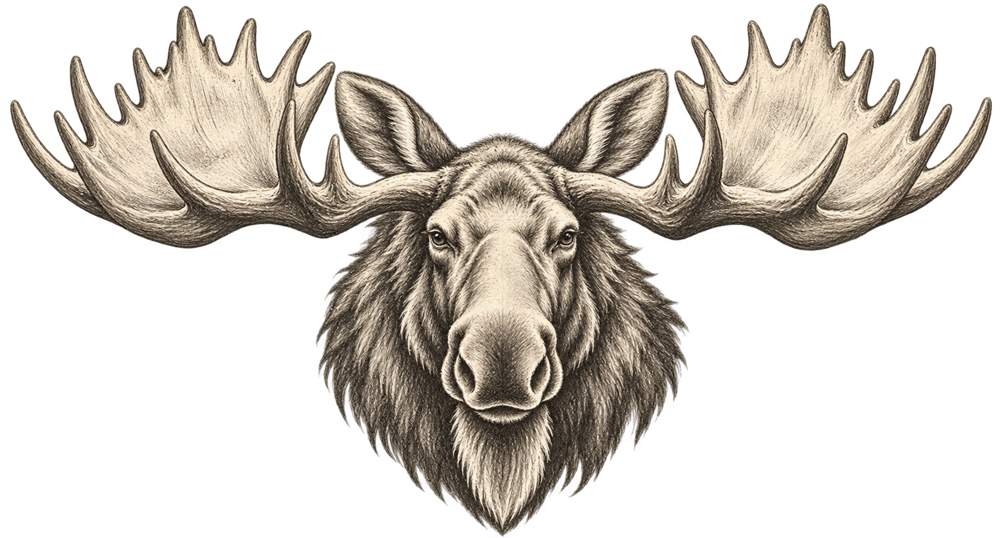
A calf’s first year begins in spring and runs through its first winter. Food, the cow’s condition, predators and winter conditions all belong in the story. Seeing a calf in summer does not tell you whether it will reach the following spring.
From autumn breeding to spring birth
Alaska’s moose account gives a pregnancy of about 230 days. Calves are born in spring. Maine’s wildlife account describes May births and usually one calf or twins, with the cow’s age and nutritional condition affecting the chance of twins.
A pair of calves is not a rule for every cow. Avoid using the twin stories in an older book as a universal birth rate, or treating one cow with twins as a measure of a whole Ontario unit.
The cow–calf year
Calves stay with their mother through their first year. Alaska’s wildlife account describes weaning in autumn and the cow driving the previous year’s young away before her next calf arrives.
That family pattern helps explain why a calf often has another moose nearby. It does not mean every lone animal is an adult. A second animal may be hidden or out of sight.
If you encounter a calf, leave it alone and keep your distance. Maine’s advice on young wildlife warns that approaching or handling a moose calf can bring a defensive response from its mother.
Separate a calf from a cow
| Feature | Calf compared with adult cow |
|---|---|
| Face | Shorter face and smaller muzzle. |
| Body | More leg in relation to body; narrower-looking hindquarters. |
| Head viewed from the front | More triangular-looking, with a pointed muzzle. |
| Company | Often near its mother, but this alone does not settle age. |
Ontario recommends using several features together. Distance, footing and a partly hidden animal can make size misleading. Use its official photographs to study the comparison before hunting.
Remember that a bull without visible antlers adds another identification problem. Read Antlers, and pause until you have enough of a view.
Why survival matters
Births and survival are separate questions. A record of cows with calves in one season should not be labelled a count of calves that survived the year.
On Populations, Predators & Disease, we explain how survey counts and estimates differ and why one observation needs its place, date and method attached.
Sources & further reading
- Alaska wildlife department: pregnancy and the calf’s first year ↗
- Maine wildlife department: calving and twins ↗
- Ontario: cow and calf identification ↗
- Maine: leave young wildlife alone ↗
Sources checked October 14, 2026. Survey years and historical publication dates are stated where used.